Hetzner vs DigitalOcean: Pricing, Regions and Backups
Hetzner vs DigitalOcean: Pricing, Regions and Backups

For a US team in late 2026, DigitalOcean is the cheaper and simpler pick at most small server sizes, while Hetzner pulls ahead on heavy outbound traffic and raw performance per dollar. Whichever you choose, the provider’s built-in backups only protect you inside that provider’s account. A scheduled snapshot that also lands in a bucket you own is what makes the choice reversible. We cover both sides below: what each costs, where each is faster, and how to back up either one without extra scripts.
TL;DR
- After Hetzner’s 15 June 2026 US price adjustment, DigitalOcean Droplets are cheaper at the 2, 4, 8 and 16 GB sizes, by $8.49 to $45.49 a month.
- Hetzner wins once outbound traffic climbs: for a 4 GB US server the cost lines cross at roughly 6 TB a month.
- DigitalOcean has the broader managed catalog (databases, Kubernetes, App Platform). Hetzner is the leaner, hands-on option.
- Both bill backups at about 20% of the server price, and neither lets you treat provider snapshots as your only copy.
- VPS Snaps schedules snapshots through either provider’s API and streams backup data to storage you own.
Table of Contents
- Server prices in the US after June 2026
- Bandwidth: where Hetzner catches up
- Performance and latency
- Managed services, documentation and support
- What each provider’s built-in backups give you
- Protecting data across both providers
- Backing up Hetzner and DigitalOcean with VPS Snaps
- Our view
- FAQ
- Sources
Server prices in the US after June 2026
The old advice, “Hetzner is always cheaper,” no longer holds for US locations. According to DeployManage’s October 2026 comparison, Hetzner raised its US prices on 15 June 2026. Here is what that did to the common sizes:
| Size | Hetzner US (shared) | DigitalOcean Basic Droplet | Difference |
|---|---|---|---|
| 2 GB | $20.49 (CPX11, 2 vCPU) | $12 (1 vCPU, 50 GiB disk) | $8.49 |
| 4 GB | $37.49 (CPX21, 3 vCPU) | $24 (2 vCPU, 80 GiB disk) | $13.49 |
| 8 GB | $73.49 (CPX31) | $48 (4 vCPU, 160 GiB disk) | $25.49 |
| 16 GB | $141.49 (CPX41) | $96 (8 vCPU, 320 GiB disk) | $45.49 |
The same comparison notes that Hetzner bills IPv4 as a separate line, while DigitalOcean includes it. WebHostingGuide’s analysis adds that before the repricing, the 4 GB Hetzner plan cost $13.99 on a USD account and beat DigitalOcean at every traffic volume. If a comparison article still says that, check its date.
Price lists move, so treat the table as the October 2026 snapshot it is, and confirm against each provider’s pricing page before you commit.
Bandwidth: where Hetzner catches up
Both providers let inbound traffic in for free and bill what leaves your server. The difference is how much is included and what overage costs.
Per opscrew.dev’s November 2026 comparison, Hetzner’s EU plans include 20 TB of outgoing traffic, but its US CPX11 and CPX21 include only 1 TB and 2 TB. DigitalOcean pools its allowance across all Droplets on a team and charges $0.01 per GiB for overage. DigitalOcean’s own pricing page confirms the $0.01 per GiB overage rate.
The practical result, from WebHostingGuide’s arithmetic on published rates: for a 4 GB US server, DigitalOcean stays cheaper until roughly 5.9 to 6.5 TB of monthly outbound traffic. At 25 TB a month, Hetzner is about $150 ahead, because its overage is about $1.20 per TB against roughly $9.31 per TB at DigitalOcean.

So the test is your own outbound volume. A SaaS dashboard or a client’s WordPress site rarely gets near 6 TB. A media, download or video workload can. Read your last three monthly bandwidth figures from your provider’s usage page and compare them with the break-even before you decide.
Performance and latency
Performance numbers depend on the test, so use them to see direction rather than ranking.
AIMultiple’s VPS benchmark ran 4 vCPU shared, 8 GB plans in a US East data center. The Hetzner plan, listed at $18.59 a month, scored 14,493 events per second on CPU against 3,408 for the DigitalOcean plan at $48. Random-read IOPS were 59,558 against 54,295. That benchmark’s prices predate the US repricing, so the cost gap it shows is wider than today’s, but the CPU lead is a useful signal for compute-heavy jobs such as builds, encoding and batch processing.
Latency is mostly about geography. CloudPickGuide’s 2026 test measured median round trips of:
- 4 ms to DigitalOcean New York and 9 ms to Hetzner Ashburn, from New York.
- 42 ms to DigitalOcean San Francisco and 54 ms to Hetzner Hillsboro, from Los Angeles.
- 39 ms to DigitalOcean Atlanta and 43 ms to Hetzner Ashburn, from Dallas.
The test’s conclusion is that location coverage matters more than the provider. That favors DigitalOcean for US-wide audiences: by opscrew.dev’s region list, Hetzner Cloud has two US locations (Ashburn, Virginia and Hillsboro, Oregon), while DigitalOcean has 16 data centers open for new resources, including New York, San Francisco, Toronto and Atlanta. Hetzner’s strength outside the US is Falkenstein, Nuremberg and Helsinki, which suits EU customers.
If latency is critical, measure from where your users are. Tracemapper’s 33-city study found a provider that is slower from one city is often faster from another, and that routes shift hour to hour.
Managed services, documentation and support
This is where the two diverge most. DigitalOcean’s product line includes Managed Databases, App Platform, Kubernetes, Functions, Spaces object storage, Load Balancers and Block Storage in one account. Hetzner Cloud lists Block Storage, Object Storage, Load Balancers, private networks, firewalls, backups, snapshots and floating IPs, with no managed database.
SoftwareSift’s March 2026 small-business ranking names DigitalOcean best overall for growing small businesses, citing a 99.99% SLA on Droplets and one-place managed services. It places Hetzner as the best budget option.
Kuberns frames the decision as team skill: experienced infrastructure teams may like Hetzner because it stays out of the way, while product teams and startups may like DigitalOcean because it shortens the path to production.
A simple rule follows from that:
- Choose DigitalOcean if you want a managed database or Kubernetes without running it yourself, if your users are spread across the US, or if you are a freelancer handing infrastructure to a client who needs documentation they can follow.
- Choose Hetzner if you are comfortable running PostgreSQL, Docker or Coolify yourself, if your traffic is heavy, or if your customers are in Europe.
Many teams end up using both, which is exactly when backup discipline starts to matter.
What each provider’s built-in backups give you
Both providers sell backups as a percentage of the server price, and both offer snapshots as a separate, on-demand image.
| Hetzner | DigitalOcean | |
|---|---|---|
| Automatic backups | 20% of server price, daily, 7 slots | 20% of Droplet price weekly, 30% daily, or usage-based from $0.01 per GiB-month |
| Snapshot price | €0.0143 per GB-month excl. VAT | $0.06 per GB-month |
| Retention | 7 slots, tied to one server | 3 days to 6 months on usage-based plans |
| Frequency | Daily | Weekly, daily, or as often as every 4 hours |
The figures come from opscrew.dev’s November 2026 comparison, and DigitalOcean’s backup pricing and retention options match its official pricing page. Hetzner’s backup images are bound to a single server and are removed with it unless you convert one to a snapshot first.
Two DigitalOcean details matter for planning. Its support documentation says you cannot currently download backups or snapshots, and that restoring a single file means recreating a Droplet or volume from the image and copying the file across. It also says creating a backup or snapshot takes roughly 2 minutes per GB of used space, so a 200 GB disk is a multi-hour job, which affects when you schedule it.
The takeaway: provider backups are a good first layer, but the copy lives in the same account as the server. If the account is locked, a token leaks or a region has a bad day, the server and its backups go together.
Protecting data across both providers
A reliable routine has four parts, whether you run one provider or both.
- Schedule the provider snapshot through the API. DigitalOcean’s doctl CLI can create snapshots, enable backups and restore a Droplet from a backup. Hetzner’s Cloud API does the same for server images. Scripting this by hand works until a token expires or a cron job silently stops, and then nobody notices.
- Dump databases separately. A disk snapshot taken while PostgreSQL or MySQL is writing may restore in a messy state. A database dump to object storage gives you a clean, portable copy. Our guide to backing up PostgreSQL and MySQL to S3 walks through it.
- Keep a copy in a bucket you own. Back up files, Docker volumes and Kubernetes manifests to S3-compatible storage under your control. Our guides cover Hetzner Object Storage for server backups and Hetzner Storage Box.
- Log every run and set retention. A backup you cannot prove ran is a guess. Keep a record of each success and failure, and prune old copies on a schedule so storage cost stays predictable.
Teams that also want security monitoring and recovery planning around these servers can look at managed backup and recovery services as a separate layer. For the encryption side, see how to encrypt backups with GPG and age and how to protect backups from ransomware.
Backing up Hetzner and DigitalOcean with VPS Snaps
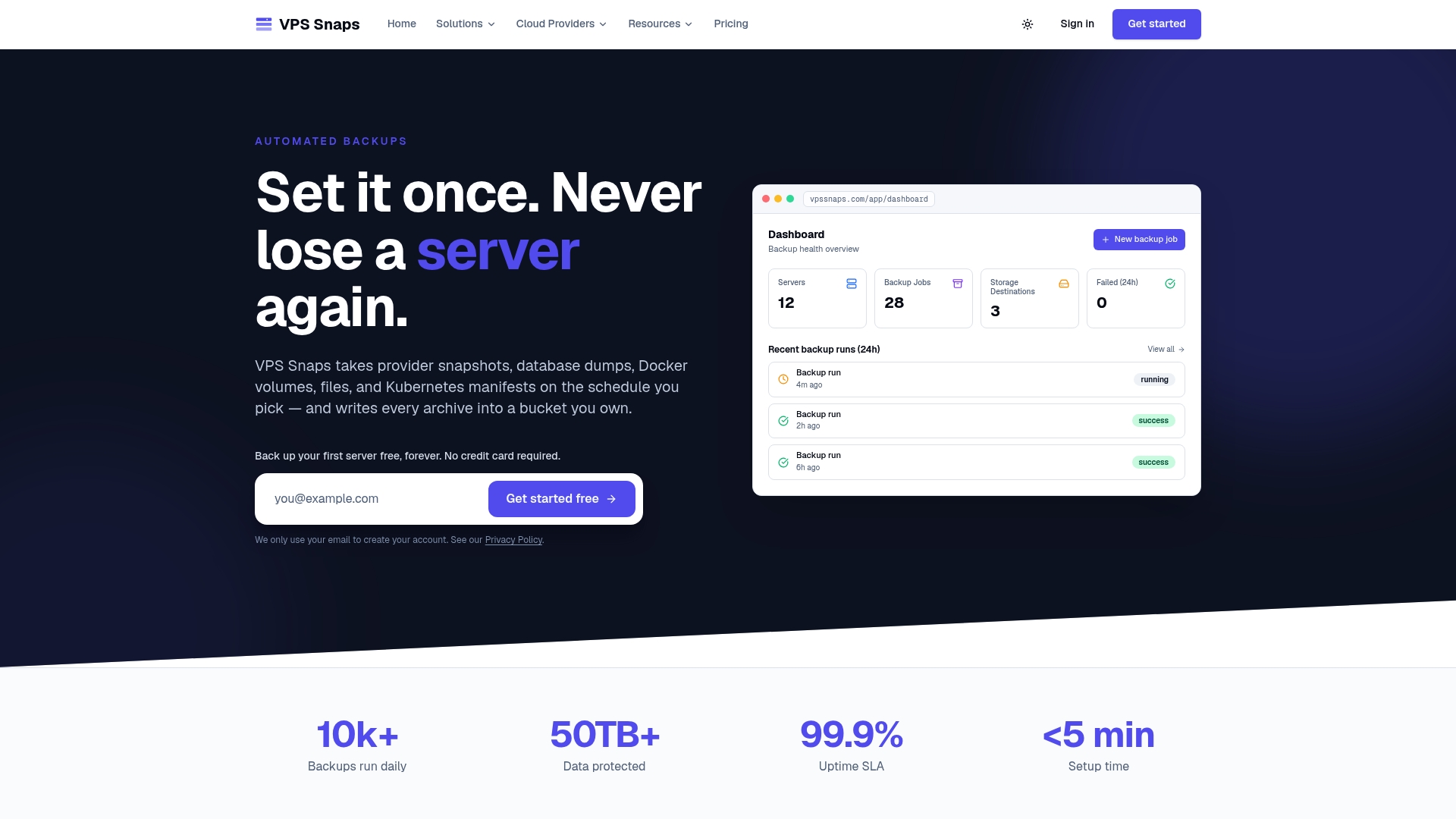
VPS Snaps is an automated, S3-compatible backup service for server environments. It integrates with seven major cloud providers, and both Hetzner and DigitalOcean are covered. It uses the provider’s API to create scheduled snapshots inside your own account, and it also handles database dumps, Docker volume backups, file backups and Kubernetes manifest and volume backups. Backup data streams directly into buckets you own, credentials are stored encrypted, and every run is written to a log that shows successes and flags failures. Retention is managed automatically.

Because snapshot artifacts stay with your provider account, you can restore them without depending on VPS Snaps. That is a real advantage when you move a workload between providers, which the price swing in 2026 shows can happen.
Provider-specific details are on our pages for Hetzner and DigitalOcean, with deeper walkthroughs in Hetzner snapshot automation and DigitalOcean snapshot automation. Plans run from a Free tier at $0 per month, then Starter at $10, Standard at $30, Pro at $57 and Agency at $117 per month, or $120, $360, $684 and $1,404 per year. See the pricing page to pick the one that matches your server count.
Our view
We do not think the Hetzner vs DigitalOcean question has one answer, and we think teams lose time arguing about it. The 2026 repricing proved the point: the provider that was cheapest in spring was not in summer. A team that tied its backups to one provider’s tooling had to rethink everything, and a team that kept backups in storage it owned did not.
Our approach is built on that idea. Backups are created through the provider’s API inside your account, streamed to a bucket you own, and logged so you can see each run. Credentials are encrypted. Snapshots stay with your provider, so you can restore without us.
Pick the server on price, region and managed services. Then make the backup portable, so the next price change is a spreadsheet exercise and not a migration crisis.
Scott
FAQ
Is Hetzner still cheaper than DigitalOcean?
Not for most US server sizes since Hetzner’s 15 June 2026 price adjustment. DigitalOcean is cheaper at 2, 4, 8 and 16 GB. Hetzner becomes cheaper for a 4 GB server once outbound traffic passes roughly 6 TB a month, and it remains strong in its European regions.
Can I download a DigitalOcean snapshot or backup?
Not currently, according to DigitalOcean’s support documentation. To recover a single file you recreate a Droplet or volume from the image and copy the file out. Keeping a separate file-level backup in your own bucket makes that recovery faster.
How much do provider backups cost?
Both bill about 20% of the server price for automatic backups. DigitalOcean charges 30% for daily backups, or usage-based pricing from $0.01 per GiB-month. Snapshots are $0.06 per GB-month at DigitalOcean and €0.0143 per GB-month excluding VAT at Hetzner.
Can I use both providers and back them up from one place?
Yes. VPS Snaps integrates with seven cloud providers, including Hetzner and DigitalOcean, so you can schedule and monitor backups across both from one account and keep the data in your own storage.
Sources
- Hetzner vs DigitalOcean Pricing for US and EU Servers (DeployManage)
- Hetzner vs DigitalOcean 2026: Prices, Egress, Alternatives (WebHostingGuide)
- Hetzner vs DigitalOcean: prices and features for a small app (opscrew.dev)
- DigitalOcean pricing
- VPS Benchmark: Hetzner vs Digital Ocean (AIMultiple)
- Cloud Provider Latency Test (2026) (CloudPickGuide)
- Cloud Latency From 33 Cities (Tracemapper)
- Best Cloud Hosting for Small Businesses in 2026 (SoftwareSift)
- Hetzner vs DigitalOcean: Which Cloud VPS Should You Use? (Kuberns)
- DigitalOcean support documentation
- doctl CLI reference (DigitalOcean)